Be careful with ETFs that have high expense ratios
Do you know why is it important?
Exchange-traded funds (ETFs) are one of the easiest ways to invest in the stock market. They offer diversification, simplicity, and low costs compared to many traditional investment products. But there is one detail many beginner investors ignore: the expense ratio.
At first, an expense ratio may look small and harmless. However, over time, it can quietly reduce a large portion of your investment returns.
What is an expense ratio?
The expense ratio is the annual fee charged by the ETF provider to manage the fund. This fee is automatically deducted from the fund’s assets, meaning you never receive a bill directly — but you still pay for it.
For example:
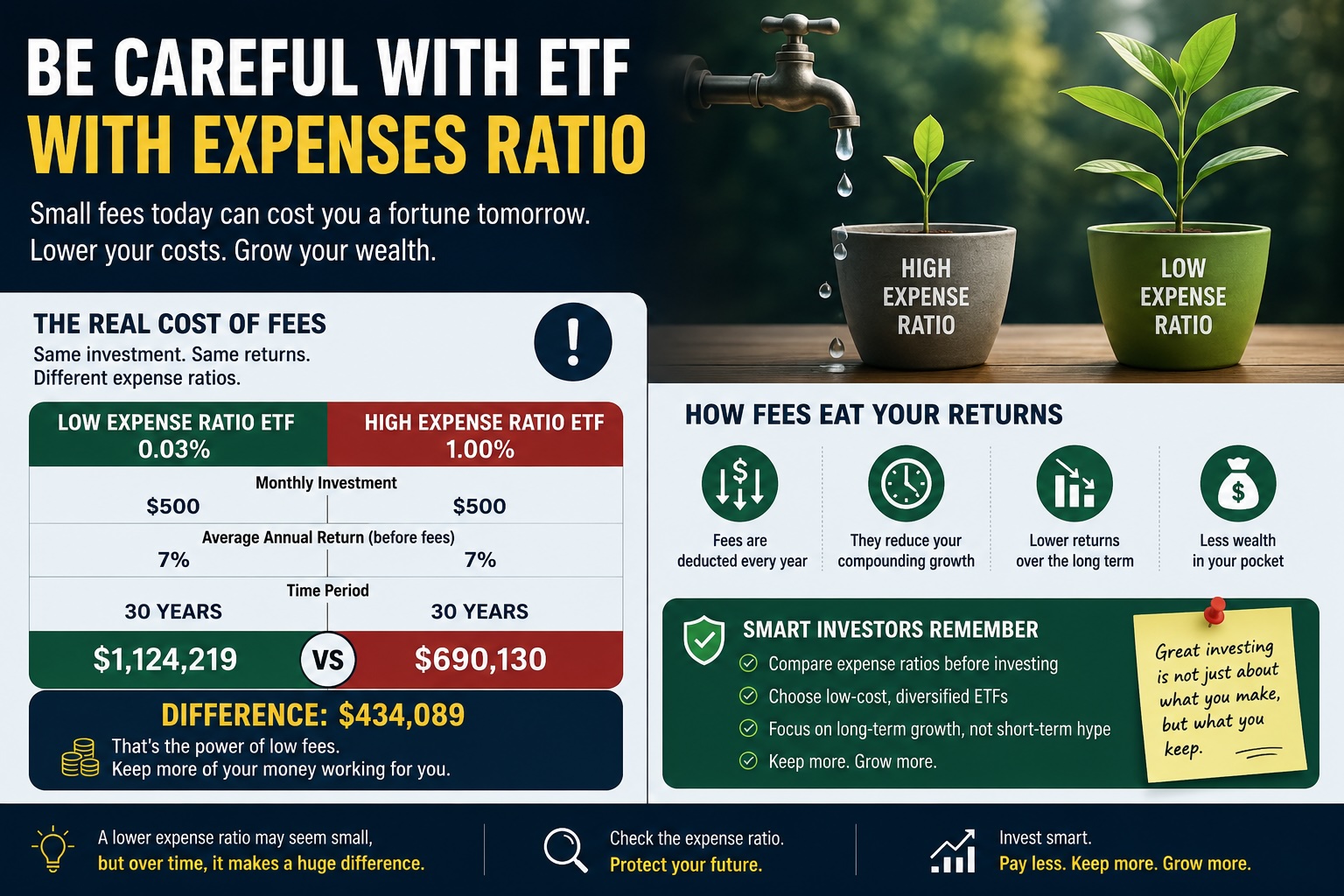
- An ETF with a 0.03% expense ratio charges $3 per year for every $10,000 invested.
- An ETF with a 1.00% expense ratio charges $100 per year for every $10,000 invested.
That difference may not seem huge in one year, but over decades, it becomes significant.
Why expense ratios matter so much
Investing is all about compound growth. The money you save on fees stays invested and continues growing over time.
Imagine two investors:
- Investor A chooses a low-cost ETF with a 0.03% expense ratio.
- Investor B chooses a similar ETF with a 1.00% expense ratio.
Both invest the same amount monthly for 30 years with the same market returns.
Even though the investments perform similarly, Investor A could end up with tens or even hundreds of thousands of dollars more simply because they paid lower fees.
The higher the expense ratio, the harder your investment must work just to overcome those costs.
Not all expensive ETFs are better
Many investors assume higher fees mean better performance. In reality, that is often not true.
Some actively managed ETFs charge high expense ratios while failing to outperform simple index ETFs like:
- Vanguard S&P 500 ETF
- Vanguard Total Stock Market ETF
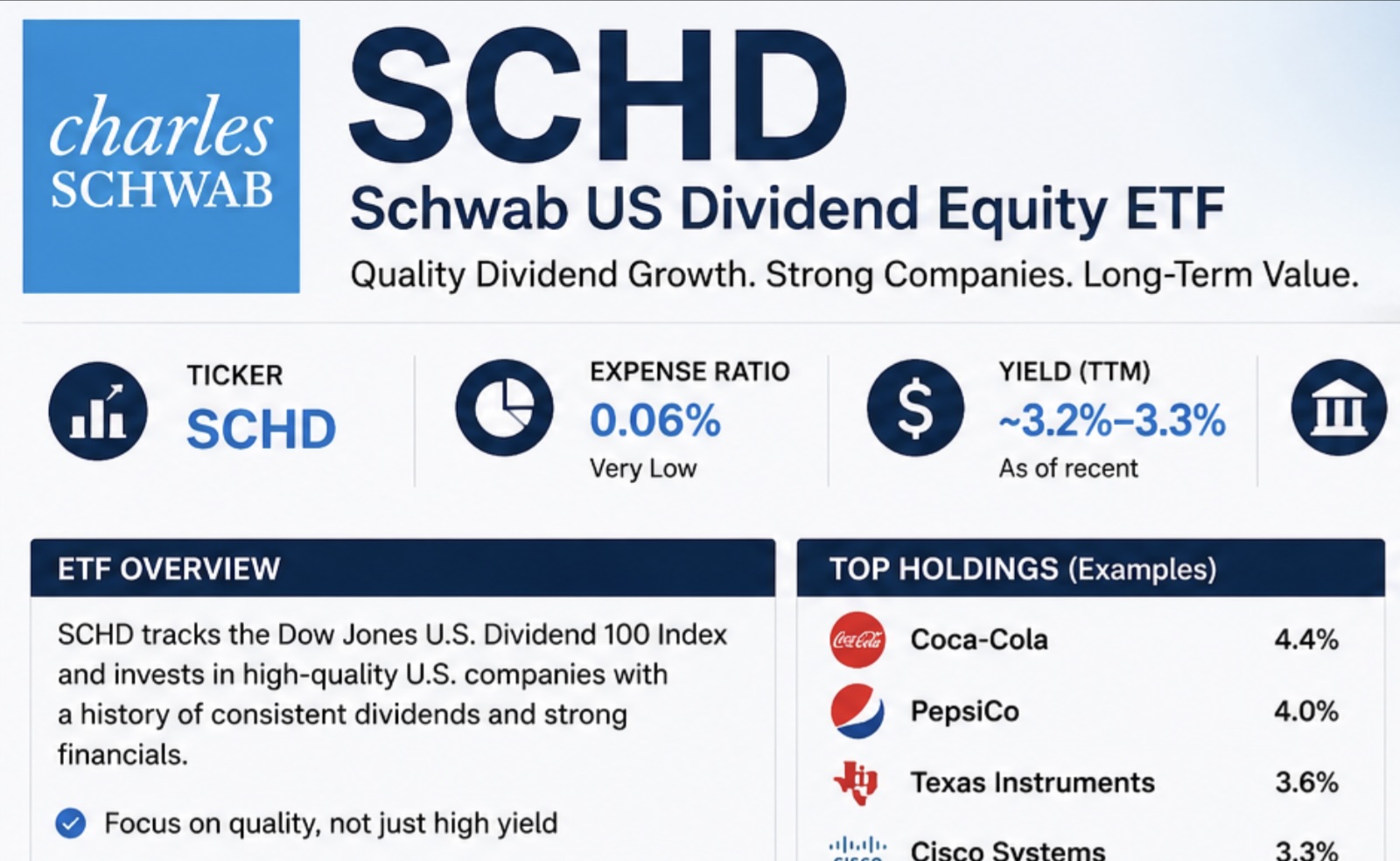
- Schwab U.S. Dividend Equity ETF
Low-cost index ETFs have historically outperformed many expensive actively managed funds over long periods.
When a higher expense ratio might be acceptable
There are situations where a higher expense ratio may make sense:
- Specialized sector ETFs
- International or emerging market ETFs
- Certain bond or commodity ETFs
- Actively managed strategies with strong long-term records
However, investors should always compare the fee with the value being delivered.
Paying 0.60% or 1.00% annually for an ETF that performs similarly to a low-cost index fund may not be worth it.
How to check an ETF’s expense ratio
Before buying any ETF, always look at:
- Expense ratio
- Historical performance
- Holdings inside the ETF
- Dividend yield
- Fund size and liquidity
Most major brokerages and ETF providers clearly display this information.
As a general rule:
- Below 0.10% = Very low cost
- Between 0.10% and 0.40% = Reasonable
- Above 0.50% = Requires closer attention
- Above 1.00% = Usually expensive
ETFs are powerful investment tools, but not all ETFs are created equal. A high expense ratio may slowly drain your returns year after year without you noticing.
The goal is not simply to find the “most exciting” ETF — it is to keep more of your money working for you.
Sometimes, the smartest investment decision is also the simplest one: choosing a diversified, low-cost ETF and holding it for the long term.
All information in this article is not a recommendation.
We show examples, and you need to analyze.
We are not responsible for your decisions and investments.
Related articles
FBTC: the alternative to Bitcoin
FBTC (Fidelity Wise Origin Bitcoin Fund) is a...

ETF SOXX
SOXX is the BlackRock iShares semiconductor ETF...
Investing 10k in VYM, 10k in JEPI, and 10k in SCHD
If you invest $10k each in VYM, JEPI, and SCHD...
ETF JEPI paying monthly
JEPI stands for JPMorgan Equity Premium Inco...
How to Invest in S&P 500?
Investing in the S&P 500 is one of the easiest...
ETF vs Stocks: Which is Better?
Choosing between ETFs and stocks isn’t about...

ETF Invesco QQQ Trust (QQQ)
Is one of the most popular exchange

Comparing IVV, VOO and QQQ
Check and see what is better for you
S&P 500 ETF SPY
Is one of the most popular exchange-traded funds
IVV S&P 500 ETF
Is one of the most popular ETFs for long-term...
Mauricio Junior